
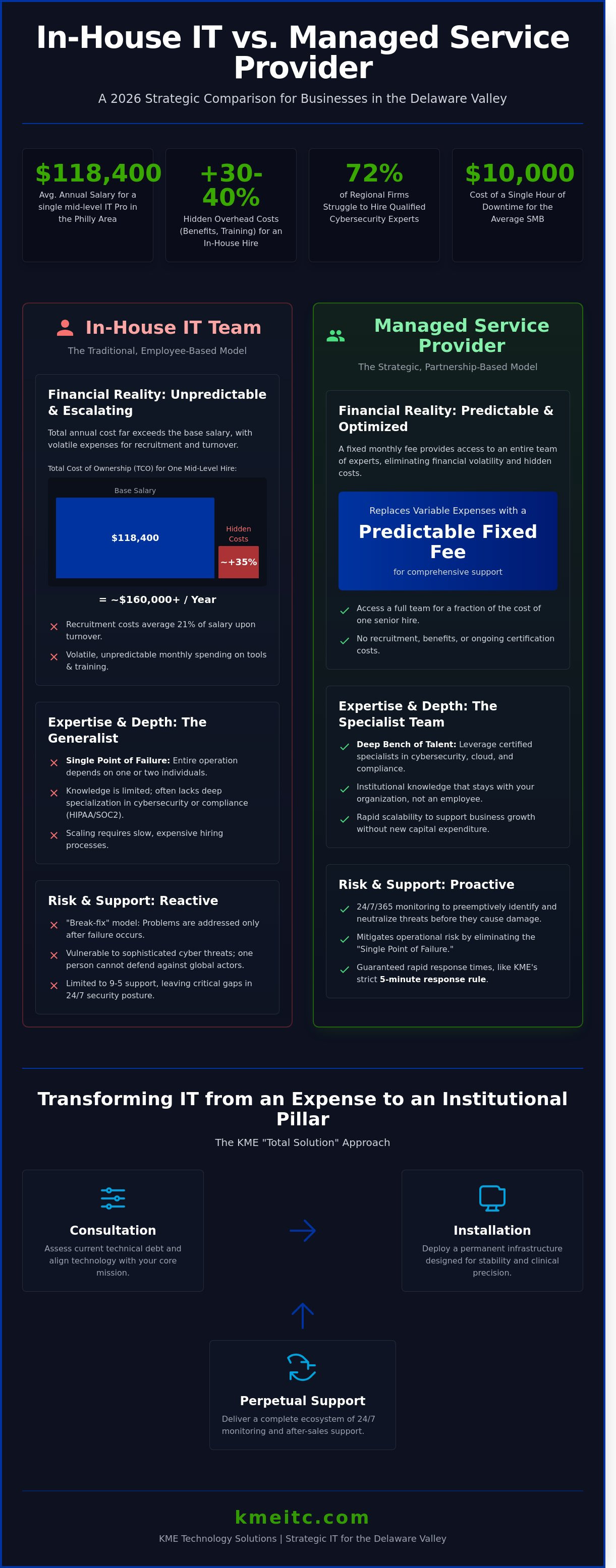
By the start of 2025, the average annual salary for a single mid-level IT professional in the Philadelphia-Camden-Wilmington corridor reached $118,400, excluding the 30% overhead typically required for benefits and ongoing certifications. You understand that the struggle to retain top-tier talent in this competitive regional market often leads to critical gaps in your 24/7 security posture and unpredictable monthly spending. The strategic choice between in-house it vs msp is no longer a simple staffing matter; it's a high-stakes determination that impacts your organization's long-term institutional stability and fiscal health.
KME Technology Solutions presents this 2026 strategic guide, offering an empirical evaluation of both models, focusing on total cost of ownership and operational integrity for businesses in Philadelphia and Mount Laurel. We'll deliver a rigorous financial comparison alongside a detailed risk assessment of current cyber vulnerabilities. You'll gain access to a structured transition framework designed to transform your technology from a fragmented expense into a comprehensive total solution that supports your mission with clinical precision and unwavering reliability.
Key Takeaways
- Analyze the total financial impact of IT staffing by uncovering the hidden burdened costs associated with full-time internal hires versus fixed-fee managed models.
- Determine the optimal model for your regional organization by comparing the scalability and specialized depth of in-house it vs msp.
- Mitigate operational risks such as the "Single Point of Failure" by leveraging a deep bench of certified specialists focused on high-stakes compliance and cybersecurity.
- Utilize a strategic framework to assess your current technical debt and infrastructure complexity against evolving industry standards in the Delaware Valley.
- Explore the "Total Solution" approach to IT management, emphasizing a lifecycle of consultation, installation, and perpetual support to ensure institutional reliability.
The Evolution of IT Management in the Delaware Valley
The technological infrastructure of the Delaware Valley underwent a radical transformation between 2020 and 2026. Local small and medium businesses (SMBs) previously relied on a single IT manager or a small internal team to maintain servers and workstations. This traditional model, known as in-house IT, places the entire burden of maintenance, security, and strategy on a limited number of payroll employees. Conversely, What is a Managed Service Provider (MSP)? It's an external organization that delivers a comprehensive suite of IT services under a proactive, subscription-based model. When evaluating in-house it vs msp, the decision hinges on whether a firm requires a generalist on-site or an institutional partner capable of delivering a total solution.
The choice between these models became a critical survival factor by early 2026. As cyber threats grew in complexity, the Philadelphia metropolitan area emerged as a primary target for ransomware due to its high concentration of healthcare and laboratory facilities. Relying on a single internal employee to defend against global threat actors is no longer a viable strategy for regional leaders. KME provides the steady, methodical oversight required to protect these vital assets, acting as a sophisticated bridge between global innovation and local operational requirements. We don't just sell services; we deliver a permanent infrastructure designed for stability and clinical precision.
The Shift from Reactive to Proactive Support
The "break-fix" model, where technicians only intervene after a system failure, is obsolete. In 2026, even sixty minutes of downtime costs the average SMB approximately $10,000 in lost productivity and data recovery. Modern business demands 24/7 monitoring to preemptively address vulnerabilities before they manifest as critical failures. This is especially true in the post-remote work environment where 65 percent of the regional workforce utilizes hybrid access points. KME addresses this by implementing a strict five-minute response rule. This standard ensures that regional healthcare providers and government entities receive immediate technical intervention, effectively eliminating the delays inherent in traditional internal ticket queues. Our approach moves beyond simple troubleshooting to provide a complete ecosystem of perpetual after-sales support.
Regional Market Pressures in South Jersey and Philly
The labor market in Moorestown, Medford, and Cherry Hill presents a significant challenge for internal hiring. Recent 2025 labor statistics indicate that 72 percent of regional firms struggle to find qualified cybersecurity experts. This talent shortage drives the average salary for a mid-level IT manager in the Philadelphia metropolitan area to over $115,000 annually, excluding benefits and taxes. Choosing between in-house it vs msp involves weighing these rising costs against the specialized knowledge required for regional compliance. Organizations must adhere to rigorous HIPAA and SOC2 standards, which demand the deep institutional expertise that a generalist often lacks. KME provides access to a full team of specialists for a fraction of the cost of a single executive hire, ensuring excellence and integrity in every diagnostic and operational layer.
- Talent Scarcity: Competition from major Philly tech hubs makes retaining internal talent expensive and difficult.
- Compliance Rigor: Specialized regional mandates require dedicated experts in molecular pathology and diagnostic imaging data security.
- Scalability: MSP models allow for rapid expansion that internal teams cannot match without significant capital expenditure.
The Financial Reality: Comparing In-House Salaries to MSP Fees
Organizations evaluating in-house it vs msp models must look beyond the base salary of a single technician. The fiscal commitment of an internal department involves a complex architecture of recurring expenses. A full-time hire demands a predictable salary, yet the peripheral costs often inflate the total budget by 30% to 40%. These burdened costs include payroll taxes, health insurance premiums, 401(k) matching, and specialized training certifications. When an internal staff member resigns, the organization faces a recruitment cost averaging 21% of that employee's annual salary. This creates a volatile financial environment that many Philadelphia businesses find difficult to sustain.
The total cost of ownership for internal staff remains high because technology never stops evolving. To maintain excellence, an internal team requires an annual budget for professional development and lab environments for testing. Without these investments, the staff's skills stagnate, leaving the business vulnerable to modern threats. A managed it support provider eliminates these variable costs by offering a fixed fee structure. This financial stability allows leadership to focus on long term growth rather than fluctuating payroll demands.
2026 Salary Benchmarks for Philadelphia IT Professionals
Projected data for 2026 indicates that an IT Manager in Mount Laurel, NJ, will command an average base salary of $128,400. This figure excludes the $15,000 to $20,000 required for competitive benefits and professional development. Relying on a single individual creates a precarious single point of failure for the organization. Most generalists lack the bandwidth to implement cybersecurity best practices for small businesses while managing daily hardware tickets. This gap in specialized knowledge often necessitates hiring outside consultants, which adds unexpected layers to the annual budget. KME provides a team of specialists for a fraction of the cost of a single executive hire, ensuring that no expertise gaps exist in your infrastructure.
The Scalability Advantage of Managed Services
Managed services transition IT spending from a capital expenditure (CapEx) model to a predictable operational expenditure (OpEx) framework. This shift allows CFOs in the Philadelphia metro area to allocate capital toward core medical or business equipment rather than depreciating server hardware. A fixed monthly fee eliminates the shock of emergency repairs or sudden hardware failures. For a 50-person firm, the ROI of downtime prevention is substantial. If an outage costs $250 per minute in lost productivity, a single four-hour event results in a $60,000 loss. The in-house it vs msp debate often ends when businesses realize that proactive monitoring prevents these losses before they impact the bottom line.
Scalability is a core component of the KME "Total Solution" philosophy. As your business expands from 20 to 100 employees, an MSP scales your support and security protocols instantly. You don't have to worry about the logistical strain of hiring and onboarding new technical staff during a growth phase. We suggest a comprehensive IT auditing session to identify exactly where your current internal model may be leaking capital through hidden inefficiencies. This methodical approach ensures your technology remains a pillar of your institutional strength rather than a mounting financial burden.
- Direct Salary: $128,400 (Mount Laurel Average)
- Burdened Costs: $38,520 (Taxes, Benefits, Insurance)
- Training & Tools: $12,000 (Annual average)
- Total Internal Cost: $178,920 per year
By contrast, a managed partnership provides a full team of engineers, 24/7 monitoring, and strategic leadership for a predictable monthly investment. This provides the clinical precision required in high stakes environments while maintaining fiscal integrity.
Expertise and Depth: The Generalist vs. The Specialist Team
Relying on a single internal IT employee creates a precarious Single Point of Failure for any local organization. When that individual is unavailable due to illness, personal emergency, or scheduled leave, the technical infrastructure remains unmonitored and vulnerable. KME eliminates this risk by providing a deep bench of certified specialists who focus on distinct pillars including Cloud architecture, Cyber defense, and VoIP systems. This collective model ensures that 24/7/365 coverage isn't just a theoretical goal but a standard operational reality. Many regional businesses reach a tipping point where the complexity of their network exceeds the capacity of one person; recognizing when to outsource IT operations is essential for maintaining institutional stability.
A primary distinction in the in-house it vs msp comparison is the shift from reactive maintenance to strategic growth. Internal generalists often spend 80% of their time resolving routine support tickets, which leaves little room for long-term planning. Our team reverses this ratio. We apply institutional knowledge to ensure your network doesn't just function but actively scales. We provide a level of redundancy that internal departments cannot match; while your staff takes time off, our entire Security Operations Center remains vigilant. This continuity is vital for organizations that view their technology as a pillar of their professional responsibility and a driver of their local reputation.
Cybersecurity: A Full-Time Requirement
Global threat actors in 2026 are utilizing AI-driven polymorphic malware that evolves faster than any single human can track. A solo IT manager cannot stay ahead of these sophisticated adversaries while also managing local hardware and user requests. KME leverages collective intelligence gathered across hundreds of client networks to identify emerging patterns before they reach your perimeter. Our approach to advanced threat protection integrates endpoint security with 24/7 monitoring, ensuring that 99.9% of potential breaches are neutralized before they disrupt operations. We treat cybersecurity as a clinical necessity rather than an optional safeguard, mirroring the precision required in modern medical environments.
vCIO Services and Strategic Consulting
KME provides every partner with a Virtual Chief Information Officer (vCIO) to bridge the gap between technical operations and executive vision. This role isn't about fixing computers; it's about aligning every technology investment with your 5 year growth plan. We move beyond simple troubleshooting to deliver a Total Solution that empowers the entire organization. By conducting quarterly business reviews and lifecycle budgeting, we ensure your infrastructure reflects global standards of excellence. This methodical planning transforms IT from a recurring expense into a strategic asset that drives long term stability. We don't just manage systems; we partner with you to ensure your technological ecosystem supports your broader mission with integrity.
Strategic Decision Framework for South Jersey SMBs
Selecting between in-house it vs msp requires a methodical evaluation of organizational maturity and operational risk. Decision makers must first quantify their technical debt. A 2023 study indicated that 31% of SMB technology budgets are diverted to maintaining legacy systems rather than driving innovation. If your South Jersey firm manages aging servers or fragmented software ecosystems, the maintenance burden often exceeds the capacity of a single internal hire. This technical debt creates a cycle of reactive fixes that prevents long term growth.
Infrastructure complexity dictates the required depth of expertise. Healthcare providers in Burlington County must adhere to rigorous HIPAA and HITECH standards. These regulations demand documented security protocols that internal generalists often lack the bandwidth to maintain. Failure to meet these standards results in significant financial penalties; average HIPAA violation fines reached $25,000 per incident in 2023 enforcement actions. KME provides the institutional oversight necessary to navigate these complex regulatory environments, ensuring your practice remains both compliant and operational.
Calculating the cost of downtime provides the clearest metric for this decision. For a typical firm with 25 employees, an hour of total network failure costs approximately $1,650 in lost productivity and missed opportunities. This calculation doesn't include the long term reputational damage or the loss of client trust. If your current structure cannot guarantee a return to operations within 60 minutes, the financial risk necessitates a more robust support model. Reliability isn't a luxury; it's a fundamental requirement for business continuity.
The Co-Managed IT model serves as a strategic bridge. It allows your existing staff to focus on proprietary business logic while KME manages the underlying infrastructure, security, and 24/7 monitoring. This "Total Solution" approach ensures no single point of failure exists within your technical leadership. It empowers your internal team by removing the burden of routine maintenance.
When In-House IT Makes Sense
Large scale enterprises with proprietary, custom built systems often require dedicated internal teams. These organizations usually maintain over 250 users and possess the capital to fund a full department. Certain industrial sectors also require an immediate, physical on-site presence for manual hardware adjustments every hour. However, internal staff frequently struggle with comprehensive cybersecurity. They lack the exposure to diverse threat vectors that a dedicated security operations center encounters daily.
When an MSP is the Superior Choice
When conducting a final comparison of in-house it vs msp, firms often find that if a Cherry Hill or Mount Laurel business has expanded by 15% in the last 12 months, they've outgrown their current support. Distributed or hybrid teams require 24/7 monitoring to remain productive across different time zones. Professional service providers deliver specialized knowledge for complex projects like cloud migrations. These turnkey solutions eliminate the risk of project delays common with overstretched internal staff.
The KME Total Solution: Reliability as an Institutional Pillar
KME approaches technology with the same clinical precision required in molecular pathology or diagnostic imaging. We don't view IT as a series of isolated hardware purchases or reactive repairs. Instead, our philosophy centers on the Total Solution. This framework integrates expert consultation, seamless installation, and perpetual support into a single, cohesive ecosystem. When evaluating the merits of in-house it vs msp models, the primary differentiator is this level of institutional responsibility. KME operates as a permanent fixture in the regional medical and business infrastructure, ensuring every technological deployment aligns with global standards of excellence and integrity.
Our headquarters in Mount Laurel, New Jersey, provides a strategic advantage for organizations that need IT support in the Philadelphia metropolitan area. In 2024, our field engineers maintained an average on-site arrival time of 42 minutes for critical hardware failures requiring physical intervention. This physical proximity eliminates the delays inherent in national provider models and ensures South Jersey SMBs receive immediate, high-stakes support. We empower our partners by removing the burden of technical management, allowing them to focus on their core mission of public health and commercial growth.
A comprehensive IT audit is the first step toward achieving this operational stability. For Philadelphia businesses, this audit serves as a diagnostic tool, identifying vulnerabilities in data security and infrastructure efficiency. We provide a clear roadmap that replaces ambiguity with factual, data-driven strategies for long-term scalability.
Our Five-Minute Response Guarantee
Minutes matter in clinical and high-pressure business environments. KME maintains a 24/7 help desk infrastructure specifically designed to achieve a five-minute response guarantee for all critical service tickets. We've optimized our internal routing protocols to ensure that 96% of all incoming requests are acknowledged and addressed by a certified technician within 300 seconds. This methodology has a direct impact on South Jersey SMB productivity, reducing annual downtime by an average of 22 hours per workstation compared to traditional internal staffing models.
- Redundant network monitoring prevents 85% of potential outages before they affect the end-user.
- Direct access to Tier 3 engineers ensures complex diagnostic issues are resolved without multiple hand-offs.
- Automated patch management keeps systems compliant with the latest security protocols 24 hours a day.
Partnering with KME for Future-Proof IT
Transitioning away from the traditional in-house it vs msp debate requires a methodical onboarding process. KME utilizes a strict 30-day transition timeline to ensure zero friction during the integration phase. We don't believe in one-size-fits-all packages. We customize our service tiers to match your specific organizational requirements, whether you're managing a specialized medical laboratory or a growing professional services firm. Our goal is to become an indispensable extension of your leadership team, delivering turnkey projects that anticipate future technological shifts.
As you plan your budgetary and operational goals for the coming years, institutional stability should be your highest priority. It's time to move beyond transactional IT and embrace a partnership built on proven results and global standards. You can Schedule your 2026 IT Strategy Consultation with KME to begin aligning your infrastructure with the demands of the modern marketplace. Our team is ready to deliver the reliability your organization deserves.
Securing Your Organization's Technological Future in the Delaware Valley
The strategic choice between in-house it vs msp models dictates the long-term resilience of your operational infrastructure. Organizations in Mount Laurel and Philadelphia now face a landscape where internal salary costs often outpace the efficiency of a managed Total Solution. KME has served as a cornerstone of the Philadelphia metro area since 2006, delivering the technical precision required for complex regulatory environments. We've mastered the intricacies of HIPAA and SOC2 compliance to ensure your data remains secure and accessible. Our 5-minute technician response time guarantee provides the immediate reliability your business demands to maintain its competitive edge. We don't just provide support; we act as a permanent bridge between global technological innovation and your local operational requirements. Moving forward with a partner who values institutional responsibility will empower your team to focus on growth. It's time to transition from reactive troubleshooting to a proactive lifecycle management strategy that protects your regional legacy.
Request a Comprehensive IT Strategy Quote for Your South Jersey Business
Your path to technical excellence starts with a partner dedicated to your enduring success.