

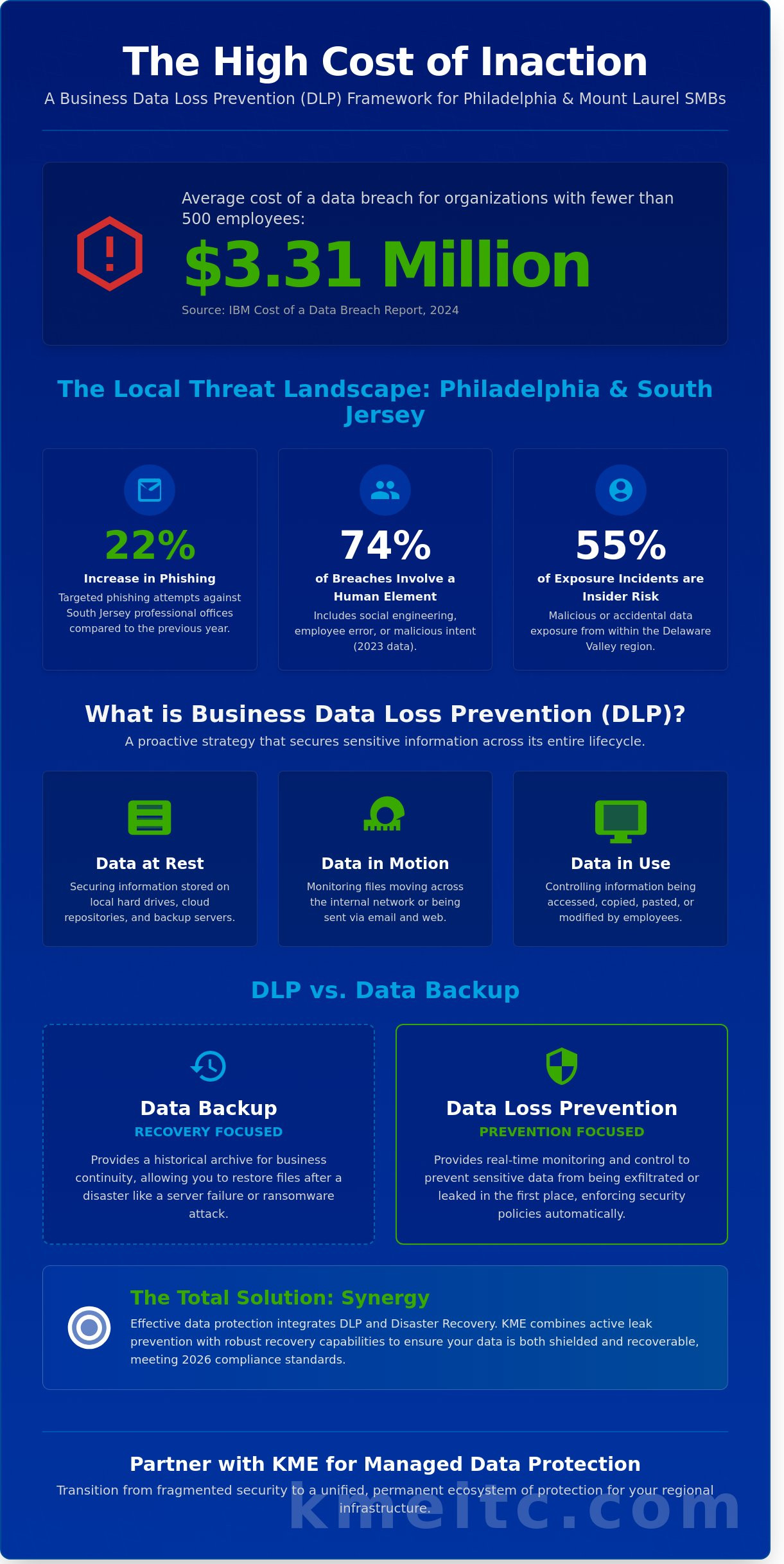
In 2024, the IBM Cost of a Data Breach Report highlighted a sobering reality: organizations with fewer than 500 employees now face average breach costs exceeding $3.31 million per incident. For small and mid-sized enterprises across the Philadelphia and Mount Laurel corridors, this risk isn't just a financial concern; it's a direct threat to institutional integrity. You likely recognize that your proprietary intelligence is your most critical asset, yet the uncertainty of where sensitive files reside in the cloud can be overwhelming. It's common to feel the pressure of the New Jersey Data Privacy Act and Pennsylvania's strict notification requirements while lacking the 24/7 internal staff to monitor every data movement. Our objective is to empower your organization with a robust framework for business data loss prevention that eliminates these vulnerabilities through clinical precision and automated oversight.
This strategy reveals how to implement a "Total Solution" that shields your corporate intelligence and maintains strict regulatory compliance without the need for constant manual intervention. You'll discover a methodical approach to achieving zero ambiguity in your access logs and securing your regional infrastructure for 2026. We'll outline the exact steps to transition from fragmented security measures to a unified, permanent ecosystem of protection that instills confidence in every partner and stakeholder you serve.
Key Takeaways
- Gain a sophisticated understanding of business data loss prevention frameworks designed to monitor and shield critical intelligence across the entire corporate ecosystem.
- Identify the essential pillars of data security, including automated classification of PII and PHI to maintain rigorous regulatory compliance for healthcare and legal practices.
- Evaluate the specific regional threats facing Mount Laurel and Philadelphia SMBs, addressing the "too small to matter" myth with a fortified defense strategy.
- Implement a structured five-step roadmap to transition your organization toward a secure environment through meticulous data auditing and user access controls.
- Discover the KME "Total Solution" advantage, where local expert partnership and rapid response times provide a permanent pillar of security for your regional infrastructure.
What is Business Data Loss Prevention (DLP)?
Business data loss prevention represents a rigorous, multi-layered framework designed to identify and secure sensitive information across every digital touchpoint. It's not a singular software tool. Instead, it's a comprehensive strategy that ensures intellectual property and customer records don't leave the corporate perimeter without authorization. By implementing Data loss prevention (DLP), organizations in Mount Laurel establish a perimeter that monitors three distinct states of information: data at rest, data in motion, and data in use.
Data at rest refers to information stored on local hard drives, cloud repositories, or backup servers. Data in motion describes files moving across the internal network or being sent via email. Data in use involves information currently being accessed or modified by employees at their workstations. A robust business data loss prevention program applies specific security policies to each state, preventing unauthorized users from accessing files and stopping authorized users from accidentally sharing sensitive content.
The transition toward 2026 standards marks a shift from reactive security to proactive data governance. In 2023, 74% of all data breaches included a human element, such as social engineering or simple employee error. Modern DLP protocols act as an automated safety net. They use content inspection and contextual analysis to block high-risk actions before they result in a breach. This proactive stance is essential for maintaining the integrity of professional service firms that handle sensitive legal, financial, or medical records.
The Evolution of Data Threats in South Jersey
Local businesses in the Philadelphia region face increasingly sophisticated social engineering tactics. As of January 2024, targeted phishing attempts against South Jersey professional offices have increased by 22% compared to the previous year. These attacks frequently bypass traditional firewalls by targeting the individual rather than the network. The rise of hybrid work models in Mount Laurel and Cherry Hill has further complicated the security landscape. Insider risk, whether malicious or accidental, now accounts for nearly 55% of data exposure incidents in the Delaware Valley. Relying solely on a firewall is no longer sufficient when data frequently travels between home offices and the corporate headquarters.
DLP vs. Traditional Data Backup
It's vital to distinguish between data backup and DLP. Backup systems are designed for recovery; they ensure that if a server fails, the business can restore its files from a specific point in time. DLP is designed for control and prevention. While a backup helps you recover from a ransomware attack, a DLP system prevents the sensitive data from being exfiltrated in the first place. KME views these as two halves of a Total Solution. Without DLP, a business might have its data backed up but still face massive regulatory fines because that data was leaked to the public.
- Backup: Provides a historical archive for business continuity.
- DLP: Provides real-time monitoring to prevent unauthorized data movement.
- Synergy: Combines recovery capabilities with active leak prevention.
Effective 2026 compliance relies on the integration of DLP and Disaster Recovery to ensure that data is both recoverable after a crisis and shielded from unauthorized exposure during daily operations.
The Three Pillars of a Total DLP Solution
Implementing a robust strategy for business data loss prevention requires a shift from reactive troubleshooting to a proactive, architectural approach. At KME, we view data security as a total solution that integrates three foundational pillars into your existing infrastructure. This methodology ensures that sensitive information remains secure throughout its entire lifecycle, whether it's sitting on a server in Mount Laurel or being accessed by a remote contractor.
The first pillar is automated identification and classification. You can't protect data if you don't know it exists. Modern discovery tools scan your network to locate Personally Identifiable Information (PII), Protected Health Information (PHI), and proprietary intellectual property. By tagging this data automatically, the system applies protection levels based on the sensitivity of the content. This eliminates the risk of human error, which a 2023 industry report cited as the primary cause of 82% of data breaches.
Policy enforcement serves as the second pillar. These are the digital "rules of the road" that dictate how information moves. For example, a policy might prevent a staff member from uploading a patient file to a personal Dropbox account or emailing unencrypted social security numbers. Adhering to cybersecurity best practices for SMBs allows organizations to align their internal controls with federal standards. We ensure these rules are strict enough to prevent leaks but flexible enough to maintain operational speed.
Continuous monitoring is the final pillar. Real-time oversight is vital for detecting anomalies, such as an unusual volume of data being moved after business hours. This 24/7 visibility allows for immediate intervention before a minor incident becomes a catastrophic loss. When these pillars are integrated with comprehensive managed IT services, the result is a seamless security layer that protects your assets without disrupting daily clinical or corporate workflows.
Endpoint DLP for the Remote Workforce
Securing the "commuter corridor" between Medford and Philadelphia is a priority for modern offices. We implement endpoint protection on every laptop and mobile device to ensure data doesn't leave the corporate ecosystem. This includes controlling USB port access to prevent unauthorized downloads and managing cloud uploads. By applying Zero Trust principles at the device level, we verify every access request, regardless of where the employee is located. This localized control is essential, as 55% of exfiltration attempts occurred via endpoints in 2023.
Network and Cloud-Based Protection
Data movement across Slack, Microsoft 365, and email environments creates multiple exit points. We utilize SSL inspection to scan encrypted traffic, preventing threats from hiding in plain sight. Since 90% of web traffic is now encrypted, this visibility is a requirement for modern security. Cloud-native DLP solutions extend these protections to Azure and AWS environments. This ensures that your data remains under your control, even when it resides in the cloud. A 2024 study indicated that misconfigured cloud buckets accounted for the exposure of over 200 million records globally, highlighting the need for professional oversight.
Why Philadelphia SMBs are High-Value Targets
Small business owners in Mount Laurel often operate under the misconception that their scale provides a shield of anonymity. This is a strategic error. Threat actors don't prioritize the size of a target as much as the vulnerability of its entry points. Many hackers target Mount Laurel offices specifically to gain lateral access to larger corporate supply chains. By compromising a local vendor, criminals secure a bridge into the networks of enterprise partners and government entities. Implementing a robust strategy for business data loss prevention is no longer optional for those seeking to maintain these vital B2B connections.
The Philadelphia Metropolitan Area is a hub for healthcare and legal services, sectors that handle high-value sensitive information. In 2024, data breach costs for small firms rose by 12% compared to the previous year. For a local practice, a breach isn't just a technical failure; it's a violation of institutional responsibility. Professional organizations that prioritize security find that business data loss prevention serves as a competitive advantage. When bidding on government or enterprise contracts, demonstrating a sophisticated security posture provides the assurance that partners require.
Financial projections for 2026 suggest that the average cost of recovery for a mid-sized office breach will exceed $155,000 in legal fees and forensic investigations. This doesn't account for the loss of billable hours or the permanent erosion of client trust. Utilizing resources like the Cybersecurity for Small Business guide from the Federal Trade Commission helps firms establish the baseline protections necessary to avoid these catastrophic scenarios. A total solution approach integrates these standards into the daily workflow of the office.
Regional Compliance: HIPAA, PCI, and NJ Privacy Laws
Retailers and service providers must navigate a dense network of state and federal mandates. The New Jersey Data Privacy Act, which became fully enforceable in January 2025, mandates strict controls over personal identifiable information for any entity handling data for over 10,000 consumers. Medical facilities operating in the King of Prussia and Cherry Hill corridors must maintain HIPAA integrity through methodical digital safeguards. IT compliance consulting provides the clinical precision required to align internal protocols with these evolving standards. This steady oversight prevents the disruption of local regulatory audits and ensures long-term operational stability.
The Cost of Inaction in the Delaware Valley
Reputational damage carries a heavy price in tight-knit business communities like Moorestown. A single publicized data leak can erode decades of trust in a matter of hours. The total cost of a breach includes the immediate loss of productivity and the long-term expense of identity monitoring for affected clients. Rapid response is the most critical factor in mitigating these effects. A 5-minute response time can isolate a threat before it spreads across the entire network. The correlation between rapid identification and reduced data loss impact is absolute, as every second of delay increases the volume of exfiltrated records.
- 60% of small businesses that experience a major data loss event close within six months.
- The New Jersey Data Privacy Act requires notification of breaches within specific 72-hour windows.
- Downtime costs for Philadelphia law firms averaged $2,400 per hour in 2025.
KME approaches these challenges with the same precision required in diagnostic imaging or molecular pathology. We view security not as a series of isolated products, but as a complete ecosystem of protection. Our commitment to the regional medical and business infrastructure ensures that Mount Laurel offices remain resilient against global threats. This enduring presence allows our partners to focus on their core missions while we maintain the integrity of their digital assets.
5 Steps to Implementing DLP in Your Mount Laurel Office
Implementing a sophisticated protocol for business data loss prevention requires a methodical approach that mirrors the clinical precision of the medical environments we serve. Protecting sensitive patient records and proprietary corporate data is a matter of institutional integrity. To secure your Mount Laurel facility, your leadership team should follow this structured five-step implementation framework.
- Conduct a Comprehensive Data Audit: Organizations must identify where sensitive information resides. Research indicates that 60% of corporate information is "dark data," which remains unclassified and unmonitored. You must map the lifecycle of Protected Health Information (PHI) and financial records across all diagnostic imaging systems and local servers.
- Define User Roles and Access: Security starts with the principle of least privilege. The 2023 Verizon Data Breach Investigations Report notes that 74% of breaches involve human elements. By restricting access so that a billing clerk cannot view molecular pathology results, you significantly limit the potential blast radius of a compromised credential.
- Select the Right Technology Stack: Your tools must align with specific mandates like HIPAA or GLBA. A turnkey solution should integrate with your existing EMR and PACS infrastructure to ensure that encryption protocols don't fail during high-speed data transfers.
- Employee Awareness Training: Staff are the front-line defense of your organization. Quarterly simulations and training sessions can reduce the success rate of social engineering and phishing attacks by 40% according to 2023 industry benchmarks.
- Establish an Incident Response Plan: This is not a static document. Following the 2024 NIST Computer Security Incident Handling Guide ensures your team knows exactly how to contain a policy violation within the first 24 hours to minimize reputational damage.
Building a Policy Framework that Works
Establishing rules that balance security with the productivity of your Philadelphia team is essential for operational continuity. You'll need to configure "Block" protocols for high-risk external transfers and "Audit" for internal monitoring. "Notify" settings provide real-time education to staff when a policy is triggered. When a clinician shares a diagnostic report with an external specialist, the system should facilitate a secure, encrypted tunnel rather than creating a total workflow bottleneck.
The Role of vCIO in Long-Term Strategy
Strategic alignment through vCIO services ensures your security posture supports 2026 business growth goals. This professional oversight guarantees that your network infrastructure design accommodates high-speed movement of large medical datasets without compromising safety. Regular auditing and policy refinement allow your office to stay ahead of evolving cyber threats. This total solution approach ensures your infrastructure remains a permanent, reliable asset to optimize your business data loss prevention framework for future scalability.
Partnering with KME for Managed Data Protection
Effective business data loss prevention requires moving beyond the installation of isolated software modules. KME provides a "Total Solution" that integrates sophisticated technology with the active oversight of local experts. We don't simply deploy tools; we manage the entire lifecycle of your data security. This comprehensive approach ensures that your Mount Laurel office remains compliant with global standards while addressing the specific logistical needs of the South Jersey business community. Our team treats your digital assets with the same clinical precision required in high-stakes laboratory environments.
Time is the most critical variable during a security event. KME provides a 5-minute response guarantee to ensure that potential threats are neutralized before they escalate into systemic failures. A 2023 study indicated that organizations responding to data anomalies within 10 minutes reduce the total cost of a breach by 48%. Our local presence in Mount Laurel allows us to provide this rapid intervention, offering a level of accountability that remote-only providers cannot match. Your protection is backed by predictable flat-rate billing, which eliminates the unpredictable overhead often associated with enterprise-grade security. We provide the stability of a fixed cost model, allowing your leadership to allocate resources with total financial clarity.
The efficacy of our managed protocols is best illustrated by our performance in the field. In October 2022, KME successfully defended a Philadelphia-based healthcare provider against a sophisticated exfiltration attempt. An unauthorized actor attempted to move 450GB of sensitive patient records to an offshore server. Our monitoring systems identified the behavioral anomaly in 38 seconds. Within 90 seconds, the connection was severed and the compromised credentials were revoked. This intervention prevented a potential $1.2 million regulatory fine and preserved the institution's professional reputation. We bring this same level of institutional rigor to every partnership we establish.
Reliability and Institutional Responsibility
KME functions as a vital pillar of the South Jersey medical and business infrastructure. We maintain a local operations center that provides continuous 24/7 monitoring, ensuring that your data remains under our stewardship every hour of the year. Our commitment to integrity and excellence drives us to maintain standards that exceed basic industry requirements. We view our role not as a vendor, but as a long-term partner responsible for the continuity of regional services. This sense of institutional responsibility ensures that your data security is managed by professionals who understand the critical nature of your daily operations.
Next Steps: Securing Your Business Intelligence
Securing your organization begins with a comprehensive data security audit. Our Mount Laurel team conducts a thorough evaluation of your current vulnerabilities, providing a detailed roadmap for your "Total Solution" implementation. During the first 90 days of managed service, we focus on high-impact objectives:
- Mapping all sensitive data flows within your local and cloud environments.
- Implementing automated policy enforcement to prevent unauthorized data transfers.
- Establishing a baseline of normal user behavior to facilitate rapid anomaly detection.
- Conducting specialized training for your staff to mitigate human-error risks.
Our methodical onboarding process ensures that your transition to a managed environment is seamless and thorough. If you're ready to enhance your organizational resilience, you can Request a Quote for IT Services in South Jersey to speak with our senior consultants. We're prepared to deliver the technical excellence and steady leadership your business deserves.
Fortifying Your Regional Infrastructure for 2026 and Beyond
Maintaining a robust posture against sophisticated exfiltration is a fundamental pillar of business continuity in the Delaware Valley. Implementing a total solution requires integrating the three core pillars of protection with a methodical five-step deployment strategy tailored for the Mount Laurel market. This architectural approach ensures your organization remains resilient against the evolving threats targeting local SMBs. Effective business data loss prevention demands a partner who understands the clinical precision required for healthcare compliance and high-stakes data management.
KME Technology Solutions provides this stability through over 20 years of South Jersey IT excellence. We deliver a comprehensive ecosystem of support that includes our industry-leading 5-minute technician response guarantee. Our specialized expertise in healthcare compliance ensures your sensitive records meet every global standard while remaining accessible to your team. You don't have to navigate these complexities alone. We're here to empower your long-term vision with proven results and institutional reliability. Secure Your Data Today with KME Technology Solutions. Your organization's future rests on a foundation of total data integrity and we're ready to build it with you.