


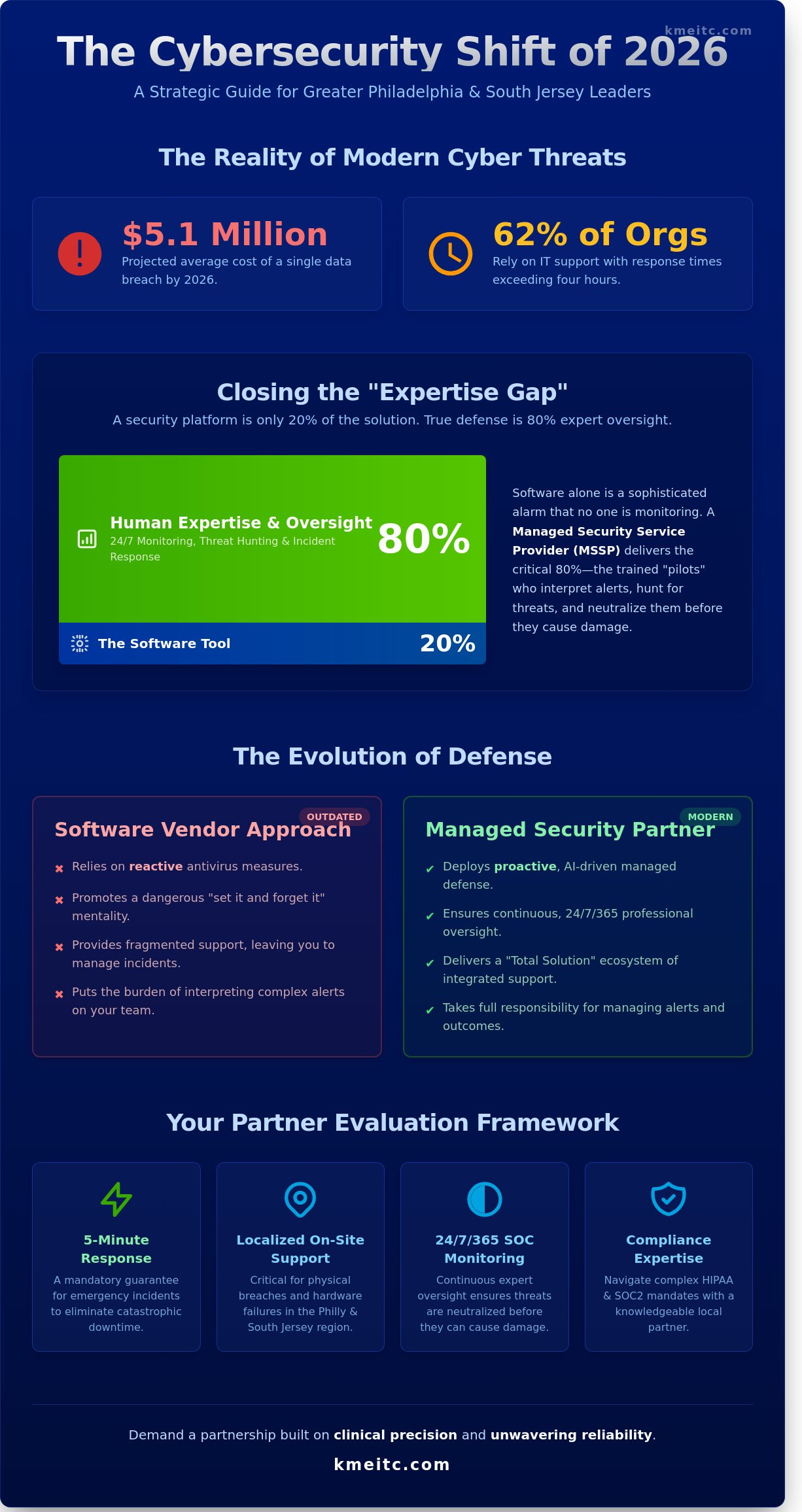
By January 2026, the average cost of a single data breach is projected to reach $5.1 million, yet 62% of mid-market organizations in the Greater Philadelphia area still rely on IT support with response times exceeding four hours. For healthcare and infrastructure leaders in Mount Laurel, these delays represent more than just technical friction; they're a direct threat to public trust and operational integrity. You've likely faced the mounting pressure of complex HIPAA and SOC2 mandates while struggling with vendors who provide fragmented support. Selecting the right cyber security providers is no longer a matter of simple procurement, but a strategic necessity to ensure your institution remains a stable pillar of the regional economy.
We understand that you demand a partnership built on clinical precision and unwavering reliability. This guide provides a framework to evaluate providers through the lens of a Total Solution, moving beyond isolated products to a comprehensive ecosystem of monitoring and compliance. You'll learn how to secure predictable monthly costs while demanding a 5-minute response guarantee that eliminates the fear of catastrophic downtime. We'll examine the specific technical benchmarks and long-term vision required to protect your South Jersey or Philadelphia enterprise against the sophisticated threat landscape of 2026.
Key Takeaways
- Identify the necessary shift from reactive antivirus measures to proactive, AI-driven managed defense to protect Philadelphia-based organizations from evolving global threat actors.
- Recognize the critical "Expertise Gap" by understanding why professional cyber security providers offer superior protection over standalone software through continuous, 24/7 alert monitoring.
- Navigate complex regional compliance landscapes, such as HIPAA and SOC2, with a strategic focus on the unique vulnerabilities facing the Greater Philadelphia medical and legal sectors.
- Apply a rigorous evaluation framework for prospective partners, prioritizing localized on-site support and a mandatory five-minute response time guarantee for emergency incidents.
- Implement a "Total Solution" ecosystem that ensures long-term institutional stability through integrated consultation, clinical precision, and perpetual technical support.
The Evolving Landscape of Cybersecurity Providers in Philadelphia (2026)
The cybersecurity paradigm in 2026 has transitioned from simple perimeter defense to a state of perpetual, AI-driven vigilance. For organizations in Philadelphia, the reliance on reactive antivirus software ended by early 2024. Modern cyber security providers now deploy autonomous threat hunting protocols that identify anomalies before a breach occurs. This proactive stance is essential as global threat actors increasingly pivot toward small and mid-sized businesses (SMBs) in the Delaware Valley. Data from the 2025 Mid-Atlantic Threat Report indicates that 58% of cyberattacks now target entities with fewer than 250 employees. These organizations often lack the internal resources to combat sophisticated ransomware, making them high-value targets for international syndicates.
A software vendor sells a product; a Managed Security Service Provider (MSSP) delivers a result. The distinction lies in the depth of engagement and the assumption of risk. While a vendor provides the tools, an MSSP manages the entire security posture, ensuring that the fundamental cybersecurity principles of confidentiality, integrity, and availability are upheld through continuous oversight. This professional shift mirrors the precision required in clinical environments, where failure isn't an option. Businesses can no longer afford the "set it and forget it" mentality of previous decades. Instead, they require a methodical partner capable of empowering their digital infrastructure with global standards and local expertise.
The 2026 market demands a departure from isolated security patches. It's no longer sufficient to secure a single endpoint or a specific server. Leading cyber security providers in the Philadelphia region have adopted a holistic methodology that treats the business as a unified ecosystem. This approach ensures that security isn't a bottleneck but a facilitator of growth. By integrating security directly into the operational fabric, firms achieve a level of resilience that allows them to withstand even the most aggressive digital incursions. This commitment to excellence and integrity defines the new industry standard, moving away from transactional sales toward long-term, strategic partnerships.
Defining the Modern Cybersecurity Provider
Modern providers operate as an extension of the client's internal leadership, maintaining 24/7 Security Operations Center (SOC) monitoring and active threat hunting. They're responsible for maintaining business continuity through redundant systems and immutable backups. A Total Solution represents a lifecycle of professional consultation, technical installation, and perpetual support that evolves with the threat landscape. This comprehensive framework ensures that every vulnerability is addressed through a structured, clinical process.
Regional Market Trends for South Jersey Businesses
Demand for localized expertise in Mount Laurel and Cherry Hill surged by 42% between 2024 and 2026. This growth reflects the complexities of the hybrid work model, which expanded the corporate attack surface into residential networks across South Jersey. Proximity is a critical factor for B2B partners. When a physical breach or hardware failure occurs, having a provider within a 30-mile radius ensures that recovery times are measured in minutes, not days. Localized presence allows for on-site forensic analysis that remote-only vendors can't match.
Managed Security vs. Software Vendors: Understanding the Service Gap
Procuring a license for advanced platforms like CrowdStrike Falcon or SentinelOne Singularity represents only 20% of a functional defense strategy. The remaining 80% of the battle involves the continuous human oversight required to interpret and act upon complex telemetry. Many organizations in Philadelphia and Mount Laurel mistakenly view software as a "set and forget" solution; yet, software without a trained pilot is merely a sophisticated alarm system that no one is monitoring. Professional cyber security providers bridge this gap by supplying the technical expertise to remediate threats in real-time before they escalate into systemic failures.
The expertise gap becomes most visible during non-business hours. Statistics from 2025 indicate that 74% of ransomware deployments occur between Friday evening and Monday morning. An unmanaged software license won't initiate a manual isolation of an infected workstation at 3:00 AM on a Sunday. Managed services ensure that a Security Operations Center (SOC) is actively hunting for lateral movement while your internal IT staff is off-duty. This level of institutional responsibility is what separates a simple software vendor from a strategic partner committed to your operational continuity.
Accountability serves as the primary differentiator in this comparison. Software vendors limit their liability through complex end-user license agreements, leaving the business to bear the full weight of recovery costs after an incident. In contrast, cyber security providers enter into Service Level Agreements (SLAs) that define specific response times and recovery objectives. When evaluating your current posture, utilizing the FTC cybersecurity framework for SMBs helps clarify where software ends and professional management must begin. A cost-benefit analysis reveals that while managed services require a higher monthly investment, they significantly reduce the Total Cost of Ownership by preventing the average $4.45 million loss associated with a major data breach as reported in 2024.
The Limitations of a Software-Only Approach
Internal IT departments often succumb to alert fatigue when managing unrefined software outputs. In 2024, the average security team received over 1,000 alerts per day, leading to a 55% rate of critical alerts being ignored or dismissed. Software lacks the contextual intelligence to navigate complex compliance audits like HIPAA or SOC2 alone. It can't validate whether a login attempt from a new IP address is a legitimate remote employee or a credential harvesting attack; it requires human intelligence to make that distinction and prevent a breach.
The Managed Provider Advantage
A managed approach delivers a total solution that incorporates proactive infrastructure maintenance. This ecosystem ensures that security is not a siloed product but a continuous process. Key advantages include:
- Vulnerability Management: Automated patching and firmware updates for all medical and office hardware to close security holes.
- Security Awareness: Training programs that reduce phishing success rates by 40% within 12 months of implementation.
- BDR Integration: Integrated data backup and disaster recovery protocols that function as a final safety net for your data.
Organizations seeking to stabilize their infrastructure often find that a comprehensive managed cybersecurity strategy provides the clinical precision and reliability necessary for long-term growth in a volatile digital environment.
Navigating Compliance and Regional Threats in the Greater Philadelphia Area
Organizations in the Delaware Valley face a specialized threat profile that national firms often overlook. In 2025, the FBI's Internet Crime Complaint Center reported that Pennsylvania ranked among the top five states for business email compromise, with Philadelphia accounting for 34% of those incidents. Local cyber security providers offer a strategic advantage by understanding the specific interplay between Pennsylvania's Breach of Personal Information Notification Act and New Jersey's Data Breach Notification Law. This regional knowledge is vital for securing South Jersey supply chains, where a 12% increase in logistics-related ransomware was recorded between 2024 and 2026. Effective defense requires a total solution that integrates real-time monitoring with local regulatory fluency.
Regional expertise allows for the deployment of security frameworks that are tailored to the local economic landscape. Whether managing a fleet of delivery vehicles in Camden or a law firm in Center City, the security requirements are dictated by both global standards and local mandates. Partnering with an expert who understands these nuances ensures that your business remains resilient against localized phishing campaigns that often exploit regional news or events to gain traction. This methodical approach to security mirrors the clinical precision required in the region's most advanced technical environments.
Healthcare and HIPAA Compliance in Moorestown and Medford
Clinics in Moorestown and Medford manage high volumes of diagnostic imaging and molecular pathology data that require absolute protection. The complexity of these datasets means that cyber security providers must implement encryption protocols that ensure zero ambiguity during data transit. It's no longer sufficient to secure the perimeter; the data itself must be resilient against unauthorized access at every stage of its lifecycle. Local providers act as a pillar of regional medical infrastructure by ensuring these sensitive data streams remain uncompromised across the entire healthcare ecosystem. This commitment to integrity supports the public health mission of our local medical community.
Turnkey security projects in the healthcare sector must account for the 2026 updates to HIPAA's Security Rule, which now place greater emphasis on the security of Internet of Medical Things (IoMT) devices. As of January 2026, 68% of healthcare breaches in the tri-state area originated from unsecured endpoint devices like networked infusion pumps or imaging workstations. A comprehensive security strategy includes perpetual monitoring of these assets to prevent lateral movement by threat actors. By delivering a total solution, providers empower healthcare administrators to focus on patient outcomes rather than technical vulnerabilities.
Financial and Legal Security Standards in Philadelphia
Philadelphia's financial district operates under stringent SEC and FINRA requirements that demand rigorous auditing. By 2026, 85% of cyber insurance carriers require organizations to undergo quarterly technical audits to maintain coverage. Your security partner must function as your auditor, verifying that SOC2 and PCI controls are active and documented. This level of oversight is essential for maintaining the trust of B2B partners and government entities who rely on your firm's stability.
In the King of Prussia tech corridor, the focus shifts to protecting intellectual property and R&D data from sophisticated actors. Following CISA guidance on cyber threats helps these firms build a defensive posture that protects their long-term market position. It's a matter of institutional responsibility to safeguard the innovations that drive our regional economy. Through disciplined implementation of zero-trust architectures, Philadelphia's legal and financial sectors can achieve a state of permanent readiness against evolving digital threats.
How to Evaluate Cybersecurity Companies: A Strategic Framework for SMBs
Selecting cyber security providers involves more than comparing line-item costs. It requires an audit of their operational maturity and their commitment to the "Total Solution" framework. This model ensures that every phase of the partnership, from initial diagnostic imaging of your network to the perpetual maintenance of firewalls, is handled by a single, accountable entity. Organizations in Philadelphia must prioritize providers who view security as a continuous lifecycle rather than a series of disconnected product installations. A provider's value isn't measured by the software they sell; it's validated by their ability to maintain institutional stability during a crisis.
A sophisticated provider maintains a 24/7 Security Operations Center (SOC) that monitors global threat feeds in real time. This facility must be staffed by Tier 3 engineers capable of interpreting complex telemetry from molecular pathology labs or high-volume financial hubs. Local presence is equally vital. If a server rack fails in Mount Laurel, a remote help desk in a different time zone can't provide the physical intervention required to restore operations. Verify that your partner can deploy on-site support to your regional office within 120 minutes of a critical failure. Precision is non-negotiable.
The 5-Minute Response Rule
Speed is critical. Gartner reports that the average cost of IT downtime reached $5,600 per minute in 2024. For a mid-sized Philadelphia firm, a two-hour delay in response can result in losses exceeding $670,000. KME eliminates this financial bleeding by guaranteeing a technician response in five minutes or less. We don't wait. Our technicians are mandated to engage with your ticket within 300 seconds. This rapid intervention prevents the lateral movement of ransomware and protects your institutional integrity.
Vetting for Long-Term Partnership
Avoid vendors who disappear after the initial installation. A true partner provides a vCIO (Virtual Chief Information Officer) to manage your long-term technological strategy. Strategy matters. This expert ensures your hardware procurement cycles align with 2026 industry standards and that your cloud migrations are optimized for both security and cost. Ask potential cyber security providers for their specific roadmap for HIPAA or CMMC 2.0 compliance. If they can't provide a documented plan for your next 36 months of growth, they're focused on a transaction rather than a partnership.
Examine the provider's mastery of industry-specific compliance frameworks. For healthcare entities, HIPAA and HITRUST certifications are mandatory requirements. For those within the defense industrial base, CMMC 2.0 Level 2 compliance must be verified through documented audits. A provider's ability to navigate these complex regulatory environments signals a level of integrity and technical precision that transactional vendors cannot replicate. Every claim of expertise should be backed by a specific certification date or a verified case study from a peer institution.
Excellence in cybersecurity is achieved through methodical planning and unwavering support. KME delivers this through a balanced architectural style that prioritizes your business's continuity and long-term vision. Our commitment to the regional medical and corporate infrastructure ensures that your data remains secure and your operations remain uninterrupted.
KME Technology Solutions: Your Local Pillar for Comprehensive Cyber Defense
KME Technology Solutions serves as the institutional backbone for organizations requiring uncompromising technical integrity. Based in Mount Laurel, our firm has maintained a regional heritage of excellence since 2006. We don't view IT as a series of disconnected tasks. Instead, we deploy a "Total Solution" ecosystem. This methodology treats your digital infrastructure with the same clinical precision required in a molecular pathology laboratory. Our role as cyber security providers involves more than just installing firewalls; we architect resilient environments that withstand sophisticated global threats while remaining accessible for local operations. We act as a steady, methodical partner for firms that can't afford the volatility of the modern threat environment.
The 5-minute response guarantee isn't a marketing slogan. It's a core metric of our commitment to regional business health. In high-stakes sectors like healthcare or legal services, a single hour of downtime can cost an organization upwards of $15,000 in lost productivity and patient care delays. By ensuring our engineers engage within 300 seconds, we mitigate risk before it escalates into a systemic failure. We bridge the gap between global technological innovations and the specific regulatory requirements of the Philadelphia metropolitan area. This ensures your business meets international standards while benefiting from a team that understands the local economic landscape.
Institutional Responsibility and Proven Results
Since our founding in 2006, KME has prioritized stability and global standards. We've spent two decades refining a formal, professional approach to IT infrastructure that mirrors the discipline of the medical field. Our history includes managing complex systems for healthcare providers where data integrity is a matter of public health. In the fiscal year of 2024, we completed a turnkey project for a regional medical equipment supplier that consolidated their fragmented data centers into a unified, encrypted cloud environment. This move reduced their operational overhead by 22% while hardening their defenses against ransomware. We deliver results through methodical planning and a commitment to excellence that avoids trendy, unproven shortcuts.
Getting Started with a Comprehensive Security Audit
The transition from a vulnerable state to a secure posture requires a structured roadmap. We begin with a rigorous audit of your existing hardware, software, and employee protocols. This process identifies critical gaps in your defense before they can be exploited by bad actors. Our 24/7 monitoring promise ensures that your network remains under the watchful eye of experts every second of the year. This perpetual oversight allows us to identify and isolate anomalies with surgical accuracy. It's a partnership built on long-term vision rather than simple transactions. To secure your organization's future, Schedule your 2026 cybersecurity assessment with KME. We empower your business to operate with the confidence that only an institutional leader among cyber security providers can provide. Our team stands ready to deliver the enduring presence your infrastructure demands for the years ahead.
Fortifying Your Digital Infrastructure for the 2026 Regulatory Environment
The 2026 threat landscape demands a transition from fragmented software tools to an integrated ecosystem of defense that bridges global technological innovation with local Philadelphia requirements. Organizations must distinguish between basic software vendors and sophisticated cyber security providers that offer a total solution for regional compliance and evolving network threats. This strategic shift ensures your infrastructure remains a permanent pillar of stability rather than a liability in an increasingly complex medical and corporate world.
KME Technology Solutions delivers this institutional reliability by applying clinical precision to every layer of your network defense. Our Mount Laurel based support team provides a 5-minute technician response guarantee alongside 24/7/365 proactive network monitoring to maintain absolute operational continuity. We don't just sell products; we empower your organization through a complete lifecycle of consultation and perpetual after-sales support. By aligning with a partner that values excellence and integrity, you're securing the long-term vision of your enterprise.
Secure Your Business with Philadelphia's Trusted Cybersecurity Experts
It's time to build a resilient future with a partner who treats your security as a vital regional necessity.